
Client briefing
For a time charterer, a vessel that consistently sails more slowly or consumes more fuel than promised can have significant financial consequences. Additional days at sea mean additional hire, disruption to the commercial schedule and potentially exposure to customers further down the contractual chain. Excess bunker consumption can add another substantial layer of loss.
Yet establishing a speed and consumption claim is rarely as simple as comparing the vessel’s advertised performance with what happened on a particular voyage.
Under English law, the precise wording of the charterparty, the weather encountered, currents and swell, the quality of the vessel’s logs and independent weather data, and sometimes the condition of the vessel’s hull can all determine whether a charterer has a viable claim.
Start with the charterparty
The starting point is always the vessel’s performance warranty. A typical time charter may describe the vessel as capable of maintaining approximately a stated speed while consuming approximately a specified quantity of fuel in “good weather”. The charter may then define good weather by reference to matters such as Beaufort wind force, Douglas sea state, swell and adverse currents.
Small differences in wording can have major financial consequences. For example, the familiar word “about” ordinarily gives owners a margin when assessing the promised speed or consumption. Equally important is whether the performance figures constitute contractual warranties at all: figures stated “without guarantee” may have a very different legal effect.
The definition of good weather is particularly important because English law traditionally uses performance during qualifying good-weather periods as the benchmark for assessing whether the vessel has performed as promised.
The “good weather” test
The established approach derives principally from cases including The Didymi and The Gas Enterprise and was considered again by the Commercial Court in The Divinegate.
In broad terms, the vessel’s actual performance during qualifying good-weather periods is compared with the warranted performance. If the vessel underperforms during those periods, the resulting deficiency may then be extrapolated across the voyage when calculating the charterer’s loss.
This can transform what initially appears to be a relatively modest discrepancy into a substantial claim. The evidence therefore matters enormously. Vessel logs, noon reports, engine data and independent weather-routing reports should be preserved and analysed against the actual contractual definition of good weather. A sophisticated weather-routing report is of limited value if its methodology does not correspond with the criteria the parties agreed.
The same applies to currents. In The Divinegate, the performance clause referred to the absence of adverse currents. The Court rejected an approach which effectively deducted the benefit of favourable currents when the charterparty had not stipulated that positive currents should be excluded.
A hypothetical example
Consider a hypothetical bulk carrier, MV Meridian, fixed for a six-month time charter at US$25,000 per day.
The charterparty describes the vessel as capable of about 12.5 knots laden on about 28 metric tonnes of fuel per day, in good weather up to Beaufort Force 4 and Douglas Sea State 3, with no adverse currents.
During a 6,000-nautical-mile laden voyage, the charterer becomes concerned that the vessel is repeatedly failing to achieve the expected speed. Independent routing data identifies several substantial periods satisfying the charterparty’s good-weather criteria.
Analysis demonstrates that, after applying the contractual allowances, the vessel’s good-weather performance is below the warranted level. Suppose the resulting deficiency, properly extrapolated across the voyage, produces 20 hours of recoverable time loss.
At US$25,000 daily hire, the time element alone is approximately US$20,833. There may additionally be a bunker claim depending upon the vessel’s actual consumption and the applicable contractual methodology.
If similar deficiencies occur over numerous voyages during a lengthy charter, the cumulative claim can quickly become commercially significant.
This hypothetical closely reflects the type of problem considered in The Divinegate. There, the Court applied the established good-weather methodology and found that failure to achieve the warranted 12.5 knots resulted in approximately 16 hours’ time loss. Importantly, the vessel’s logs indicated that the engine had been operated at reduced speed in an effort to remain within the contractual consumption warranty rather than because weather required the reduction.
That illustrates an important commercial point: owners cannot necessarily solve a consumption problem simply by reducing engine output if doing so means that the vessel fails to perform at the required speed.
Can engine RPM prove the claim instead?
Charterers sometimes have compelling engine data showing that the vessel has operated consistently below expected RPM. That can naturally raise the question: why should the charterer have to rely upon weather analysis when the engine records themselves suggest that the vessel was not being driven sufficiently hard?
The Divinegate demonstrates the difficulty. The Court was not persuaded that an alternative RPM methodology provided a sufficiently reliable basis for calculating time loss. RPM alone does not necessarily establish what speed the vessel should have achieved: hull resistance, weather and other operational variables must be considered.
Nevertheless, engine records remain potentially important evidence. They may help explain why a vessel underperformed and may support an allegation that owners or the master failed to proceed with the contractual degree of despatch.
And what if the hull is fouled?
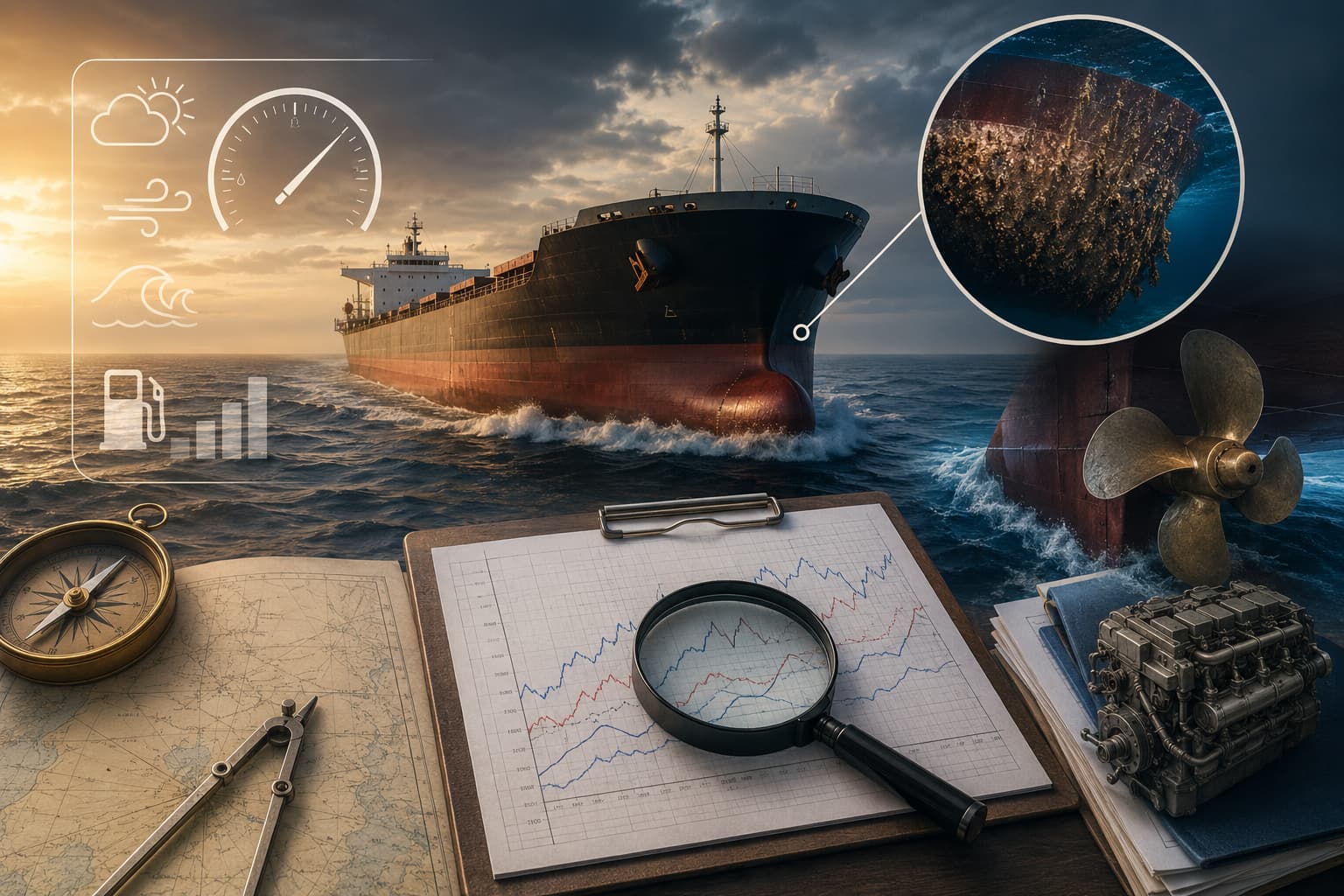
Hull fouling adds another layer of complexity. Marine growth increases resistance through the water and can consequently reduce speed while increasing fuel consumption. The commercial effects can therefore look almost identical to an ordinary speed and consumption claim.
Responsibility, however, may depend upon how and when the fouling developed and what the charterparty says. If fouling develops through ordinary trading, owners may face arguments based upon their maintenance obligations. Conversely, modern charterparties frequently contain specific bottom-fouling provisions dealing with prolonged stays in tropical or high-risk waters pursuant to charterers’ orders. Those provisions can shift responsibility for inspection, cleaning, time and cost.
Charterers should also avoid double recovery. This was another important aspect of The Divinegate. Where the established performance calculation already compensated the charterer for the consequences of underperformance, a separate claim for time lost through hull fouling could not simply duplicate the same loss.
Underperformance is not automatically off-hire
Another common mistake is to assume that because a vessel is performing below warranty she must therefore be off-hire. That does not necessarily follow.
A speed and consumption claim is ordinarily a damages claim for breach of the performance warranty. An off-hire claim depends upon satisfying the particular requirements of the charterparty’s off-hire clause.
The distinction can materially affect both the legal analysis and calculation of the claim. It should therefore be considered before hire is deducted rather than after a dispute has crystallised.
What should charterers do when performance deteriorates?
The most important step is to investigate early. A charterer confronted with apparent underperformance should immediately preserve the fixture recap and charterparty, noon reports, deck and engine logs, bunker records, RPM data and communications with the vessel. Independent weather-routing evidence should be obtained, but its methodology must be checked carefully against the contractual performance clause.
The charterer should then distinguish between time loss, excess bunker consumption, off-hire and any hull-fouling issue, rather than combining them into a single generic “underperformance” deduction.
This is particularly important before withholding hire. Performance claims may support an equitable set-off against hire, but deductions should be made in good faith and on reasonable grounds and charterers should be capable of substantiating their calculations promptly.
For businesses operating multiple vessels or long-term chartering programmes, the financial consequences can be considerable. A difference of only a fraction of a knot may appear insignificant on a daily report. Across thousands of nautical miles, repeated voyages and substantial daily hire and bunker rates, it can translate into a significant claim.
The key is therefore not simply identifying that the vessel appears slow. It is establishing what the charterparty promised, what the vessel actually achieved under the contractually relevant conditions, why the deficiency occurred, and what financial loss properly follows from it.
Early legal and technical analysis can make the difference between an unsupported deduction from hire and a properly evidenced performance claim.
