
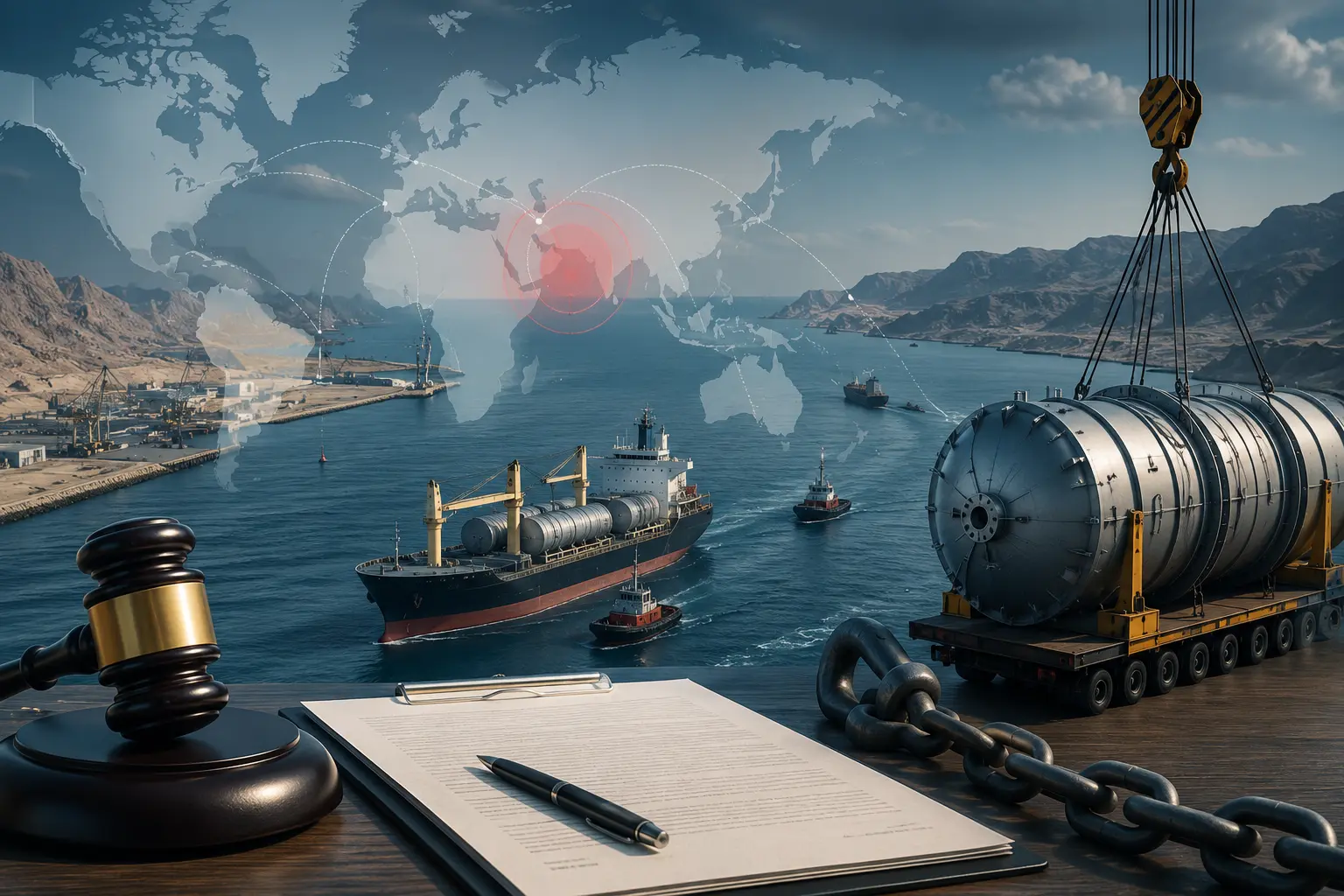
For project-cargo operators, disruption in the Strait of Hormuz is never simply a navigation issue. A decision made for the safety of the vessel and crew can immediately affect the contractual route, delivery programme, port arrangements, insurance, freight, detention, cargo security and the project’s critical path.
This is particularly acute in heavy-lift trades. The cargo may be unique, the vessel specially selected, lifting arrangements engineered months in advance and discharge coordinated with contractors, cranes, barges and site teams. Unlike ordinary commodity cargo, it may be impossible to substitute the vessel or change the discharge port without substantial cost and delay.
In my experience advising on project-cargo charterparty disputes, the principal risk is often not the geopolitical event itself. It is the absence of a clear contractual and operational framework for what happens next.
War-risk clauses are the starting point, not the conclusion
The first question is usually whether the charterparty permits owners to refuse an order, delay transit, deviate or proceed to an alternative port. The answer depends on the precise wording, including any amendments to the standard form.
BIMCO revised its voyage and time-charter war-risk clauses in 2025, partly to address changing geopolitical conditions and demands for greater transparency concerning additional insurance premiums and crew bonuses. BIMCO recommends replacing the earlier 2013 versions in new contracts.
However, incorporating a modern clause does not eliminate disputes. It provides a framework within which decisions, notices and costs must still be scrutinised.
An owner’s safety assessment should not automatically be treated as an unrestricted right to redesign the commercial adventure. The parties must identify what the clause permits, whose judgment is relevant, whether that judgment must be reasonable, what information was available and whether the action taken was proportionate to the identified risk.
Deviation can create a second dispute
A justified decision not to transit the Strait does not necessarily justify every subsequent step. Owners may seek to wait, shelter, discharge elsewhere, return to a previous port or arrange transhipment. Each option raises different contractual issues.
A right to nominate a safe alternative port does not necessarily authorise discharge at any convenient location. The proposed port must be examined against the vessel’s capabilities, the cargo’s lifting and storage requirements, customs restrictions, onward transport, project-site access and the terms of the bills of lading.
Transhipment requires particular care. Project cargo may have been secured, lifted and insured on the basis of carriage by a named heavy-lift vessel. Moving it can create engineering risks and conflict with express charterparty restrictions, marine warranty surveyor approvals or cargo insurance requirements.
Commercial urgency should not obscure the need for contractual authority and technical approval.
Allocate the cost before it is incurred
Disputes often become most difficult when the parties agree that a safety measure was necessary but disagree about who must pay for it.
Potential costs include:
- additional war-risk premiums and crew bonuses;
- bunkers and deviation expenses;
- waiting time and detention;
- alternative-port, storage and security charges;
- surveys, towage and transhipment; and
- onward transportation to the project site.
There may also be exposure to liquidated damages or other delay claims under the underlying project contract.
The charterparty should distinguish between the right to take a protective measure and the obligation to pay for it. Those are separate questions. It should also require documentary support, prior estimates where practicable, evidence of additional insurance costs and appropriate credit for expenditure that would have been incurred in any event.
A clause allowing owners to purchase additional insurance should not become a mechanism for passing unverified or unexplained costs to charterers.
Cargo ownership and lien rights must be checked early
In project-cargo structures, the charterer is often a logistics contractor rather than the cargo owner. Bills of lading may be issued to an employer, joint venture, buyer or project company.
That distinction becomes critical if owners threaten to exercise a lien for freight, detention or other sums.
A lien clause in the charterparty does not necessarily create an enforceable right against cargo belonging to a third party. The analysis will depend on whether the clause was incorporated into the bill of lading, the scope of its wording, title to the cargo and the contractual relationships between owners, charterers and cargo interests.
An unjustified detention of high-value project cargo may generate substantial claims and intensify the losses caused by the original disruption.
Before loading, the parties should establish who owns the cargo, who will hold the bills, which charterparty terms are incorporated and what security may lawfully be demanded if payment is disputed.
“Back-to-back” protection is rarely truly back-to-back
The liabilities assumed by a logistics provider to its project client frequently exceed the protection obtained from the shipowner.
The project contract may impose fixed delivery dates, broad indemnities and liquidated damages. The charterparty may simultaneously give owners extensive war-risk liberties while excluding liability for delay or consequential loss.
That gap should be addressed expressly.
Cargo interests may need to accept defined alternative-discharge arrangements, bear specified war-related costs, waive delay claims in agreed circumstances and indemnify the logistics provider against cargo claims passed through by the carrier.
Equally, the charterparty should preserve recourse against owners where a deviation, transhipment or detention exceeds the contractual liberty relied upon.
Notices and evidence often determine the outcome
When conditions change rapidly, legal positions can be lost through informal operational correspondence.
A message agreeing that the vessel should take shelter may later be characterised as consent to an extended deviation, alternative discharge or allocation of costs. Operational cooperation should therefore be separated from contractual acceptance.
Reservations of rights should identify the disputed action and its likely consequences. Where payment is made to secure the release or continued movement of the vessel or cargo, a carefully drafted payment-under-protest notice may preserve the payer’s ability to recover the amount subsequently.
The contemporaneous record should include security advice, routing assessments, insurer communications, premium quotations, port-feasibility studies, cargo-owner instructions, surveyor input and calculations of delay and mitigation.
Preparing for the voyage that was not planned
The Strait of Hormuz remains an area in which security conditions, insurance treatment and navigational decisions can change quickly. UKMTO provides security warnings and reporting channels for merchant shipping, while the Joint War Committee’s listed-area framework affects the treatment of war risks by the insurance market.
For project-cargo businesses, the best protection is not a generic force-majeure provision or an assumption that standard wording will supply the answer. It is a coordinated contractual response across the charterparty, bills of lading, project contract, insurance arrangements and operational procedures.
When a voyage no longer goes to plan, the decisive question is not simply whether the vessel could safely transit the Strait. It is whether the parties had agreed who could change the voyage, what alternatives were permitted, who would bear the resulting costs and how the cargo—and the wider project—would be protected.
Early legal review of the contractual chain can prevent an operational solution to a security problem from becoming a complex, multi-party charterparty and cargo dispute.
